One of the things that is wonderful about Boise State University is the community of writers that exists on and off campus. While attending BSU, I’ve had the pleasure of meeting some of the most talented up-and-coming writers of my generation—some of them making up a fair portion of my group of friends.
Every time I get the chance to hang out with them and geek out about writing, my mind becomes crowded with questions like: How did they get into writing? What’s their writing process like? What makes them purse this passion of theirs? And on, and on, and on…With that being said, I thought what better way to get to know my fellow friends and writers than to meet up with them and talk about our shared passion. And from that thought, the idea for this series, appropriately titled “Up and Coming,” was conceived.
That said, I wanted to kick this series off with someone who has been a dear friend of mine for a while now and whose writing and poetry has left me speechless time and time again—Lupita Rodriguez.
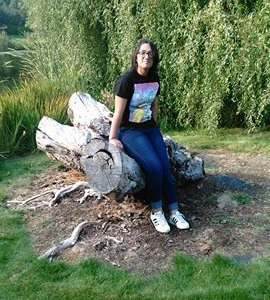
Lupita Rodriguez, like myself, is an English major with an emphasis in creative writing and has been attending Boise State for the past four years. Her poetry is filled with unbridled passion and emotion as well as utter relatability as she uses her writing to reflect on her life experiences in hopes to entertain, inspire, and connect with her readers.
But she hasn’t always pictured herself pursing poetry; Lupita considered other fields of study too. “There were other things I wanted to do,” she admitted. “They were completely unrelated [to writing], though.” She considered becoming a veterinarian, but the thought of hurting other living creatures, even if it was to help them, was something she couldn’t bring herself to do.
Her parents had other plans for her as well—her father originally wanted her to be a nurse. “His big dream was for me to be a nurse; I don’t know why. He’s like ‘I hope you be a nurse; you can really help people, or if you do go into teaching be like a kindergarten teacher.’” Lupita laughed. “First of all, kids don’t like me.” Secondly, she related her reasoning for not becoming a nurse to the same reason she decided against becoming a veterinarian.
Though her dad wanted her to go down a different career path, he was still supportive of her pursuing what made her happy, and her mother was much the same way. “At first my mom was kind of like, ‘No, don’t do that. Do something else.’ She’s the one that was like…be a secretary.” Having already had a job that involved secretarial work, Lupita ultimately decided that it wasn’t for her. Lupita summed up her mother’s thoughts on the matter: “‘You know, I know you are good at this; we hear it a lot—we hear it from you, we hear it from other people. Do what makes you happy, and…in the end, I know you’ll have like a backup plan.’ So I guess they are supportive—it’s like half and half.” We laughed together at the thought.
Parental support aside, we also discussed the different reasons we write. Diving in, Lupita explained that when she was younger writing was something she did mostly to calm herself down—to get everything out. It wasn’t until later that it developed into something more than just a therapeutic tool. “Now it has grown more, like now it’s actually…something I am passionate about; not like back when I was ten-years-old, and it was just to calm myself down. Now it’s to calm down, to entertain—not just me, other people.” On top of that, she explained that her poetry also serves to help her reflect on her life experiences and the thoughts and emotions that come with them, including those that invoke outbursts of anger.
When it comes to her poetry inspired by anger, Lupita explains, she viciously writes it out and steps away, coming back to it later with a calmer resolve to rewrite the experience. “It’s like a roller coaster, it’s just all over the place, but I think that’s how a lot of the writers are.”
A lot of her inspiration also comes from other poets and artists as well, including Lawson Fusao Inada. Inada, Lupita explained, is a Japanese American poet whose work primarily depicts his experiences living in internment camps during World War II. She took away many things from his poetry, including the importance of being humble, having gratitude, and focusing less on the materialist things in life—messages she hopes and strives to incorporate within her own poetry.
Aside from other poets, Lupita also seeks inspiration from music, Pearl Jam in particular, finding a muse in their rhythm. “I think that’s what inspires me sometimes the most…the guitar and the drums, and it just hits you hard.” Though their sound definitely sparks creativity, so do their lyrics. “They go…from societal things to historical stuff, and then they go to the obvious and cheesy whatnot love stuff. But yeah, they are like my go-to to write or just to like jam out.”
Though Lupita may get inspiration from artists like Pearl Jam and Lawson Fusao Inda, the actual writing process for herself can be a little bit of a scramble. “I will think about it and then just jot down ideas and later on lay it out, but then sometimes, like—like you said earlier—with the music on and everything, I’m just like ‘oh dang!’ and then just write all this random crap down; it’s like ‘Oh, wait! Wait! Wait! I gotta fix that!’ So it goes everywhere.”
Lupita went on to describe some of the differences between writing her longer pieces versus her shorter ones. For her longer poems, she deeply contemplates the message she is wanting to convey in them, taking her time to do so before bringing her thoughts to paper. And once she does, she hates what comes out, but then when she revisits the piece she molds it into one she loves. Her short pieces, however, come out a lot quicker and with ease, and those are her favorites.
As some of you may have already known, Lupita recently started her own Instagram poetry page, and after taking some time to mull it over, it struck me that Instagram must have been the perfect place for Lupita to showcase her shorter pieces. Still, I was curious what else might have led her to use Instagram in this way.
Lupita shared with me that one of the things that inspired her was the Instagram page of another poet by the name of Leah Stone, whom a friend of hers recommended to her. “I checked out some of her [poetry],” Lupita explained. “A lot of [Stone’s] stuff was relatable too, not just to women because she is a woman author, but for everybody.” Throughout our conversation, the importance of relatability was something that we discussed a lot. “I want to do that too,” she continued, stating that she wanted her poetry to be, “relatable not just to people like me, but everybody else.”
Being inspired by Leah Stone’s Instagram poetry and receiving an enormous amount of support from her friends and family, Lupita had made the decision to start her own page where she could showcase her original work.
And with the start of her own poetry page came a small following.
“I had a couple more followers come in…it’s not a big audience, but it’s something,” Lupita explained. “Good for us who start our own things without having to need a-thousand-and-something followers.” When talking about her following, Lupita did not seem too concerned about the size so much as how they responded to her work. So long as her readers found enjoyment and inspiration from her pieces, that was all that mattered. That and a sense of relatability.
With that said, one poem’s message that really resonated with me, and that I related to, was one captioned “About half an hour away from here,” and if you are from a small town like Lupita and I are, you might just find yourself relating to it, too.
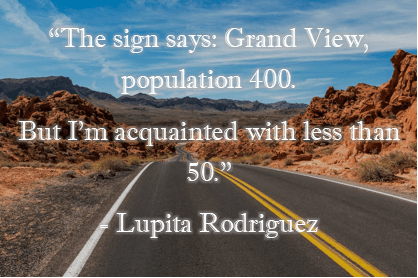
After expressing my love for this poem, Lupita laughed a bit before saying, “Thank you. I really feel like this [poem] is relatable to a lot of people who come from small towns.” Lupita revealed that it derived from a desire of wanting to get out and branch out from her small community—a desire her and I shared.
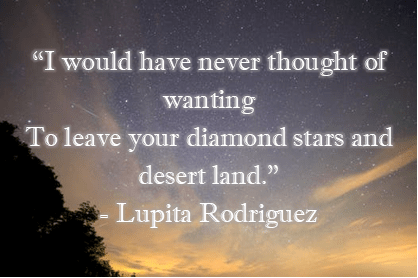
And though this desire existed within her, there were also many conflicting thoughts. “I never thought I would leave home,” Lupita admitted before explaining that people from her hometown rarely moved away. Perhaps, she speculated, since they were born and raised there they felt destined to spend the rest of their lives there too. “I guess there was a little bit of fear of my family’s gonna stay stuck there too,” Lupita shared. So while this poem acted as a way to say farewell, she explained, it also served as a way to say “Grand View, be good to them.”
Being a first-generation college student, Lapita admitted that leaving her hometown to go to college was a huge step for her. But it was one that she was glad she made. “It was kind of hard to find people back home that [liked writing] that were my same ethnicity, sometimes even…my same sex,” she elaborated; however, when she arrived at college, she met a lot of Latinos and people from different races, ethnicities, and cultures who loved writing as much as she did. She was completely taken aback. Lupita didn’t just notice the diversity in her community of writers, however, but also in the classroom. The writers they were reading came from a variety of backgrounds, including writers from the civil war and writers who were social activists.
Thinking back on the variety of writers she has read, Lupita let out a mind-blowing truth about the concept of branching out through the pursuit of your own passion. “I think that is what branching out leads to too, not just finding people in your little community, like here at Boise State, but also…seeing that there is a bigger picture to this and that you can be a part of it…” After a short pause, Lupita follows this truth up with a reflection on how pursuing writing has allowed her to branch out and has made her feel stronger than she once was. “I like the change, I really do. It makes me feel like I am not…weak anymore like I was back then. Like maybe there are still some aspects of me like ‘she is so shy’ or whatever, but writing—what you love to do—is what helps you branch out.”
Lupita’s thoughts on pursing your passion and branching out deeply resonated with me. I, like Lupita, am also a first-generation college student, and I can attest to the fact that being the first in your family to go to college is incredibly intimidating. But, again like Lupita, I am glad I did it. Following my passion for writing has led me to down some difficult yet rewarding paths. Had I not followed my passion for writing, I would not have branched out and gone on to university, and I would’ve never met and made friends with such incredible people and writers such as Lupita Rodriguez.
I wish you the best of luck on your poetic journey, Lupita. Keep on pursing what you love and branching out.
Follow Us!
Lupita Rodriquez Instagram: @lrbimagery05
My Instagram: @alt.me23
Blog post edited by Mitzi Ceballos.

 ericeamador.com
Leave a comment