Are you investing in your writing skills? Listen, I may not know much about financial investments—I live my life in the red (seriously, though, if you’d like to by me lunch, here is my Venmo)—but I do know a little something about investing in a skill set you’re trying to develop and hone.
One of the biggest investments I made toward improving my writing skills was buying a copy of Dreyer’s English by Benjamin Dreyer.
During one of my creative writing classes in college (yes, I majored in creative writing…feel free to laugh), a local author was talking about how much of a stickler she is for proper grammar and punctuation. She proceeded to give us a pop quiz like we were middle schoolers. At first, it felt a little ridiculous—until we realized that we actually sucked at knowing where to place a comma.
Despite there being the existence of magical creatures called editors, when submitting a piece of work for publication, it is important to make sure that your grammar and punctuation are on point.
Simply put, her advice to us was: Give people one less reason to say “no” to publishing your work and know where to put that fucking comma.
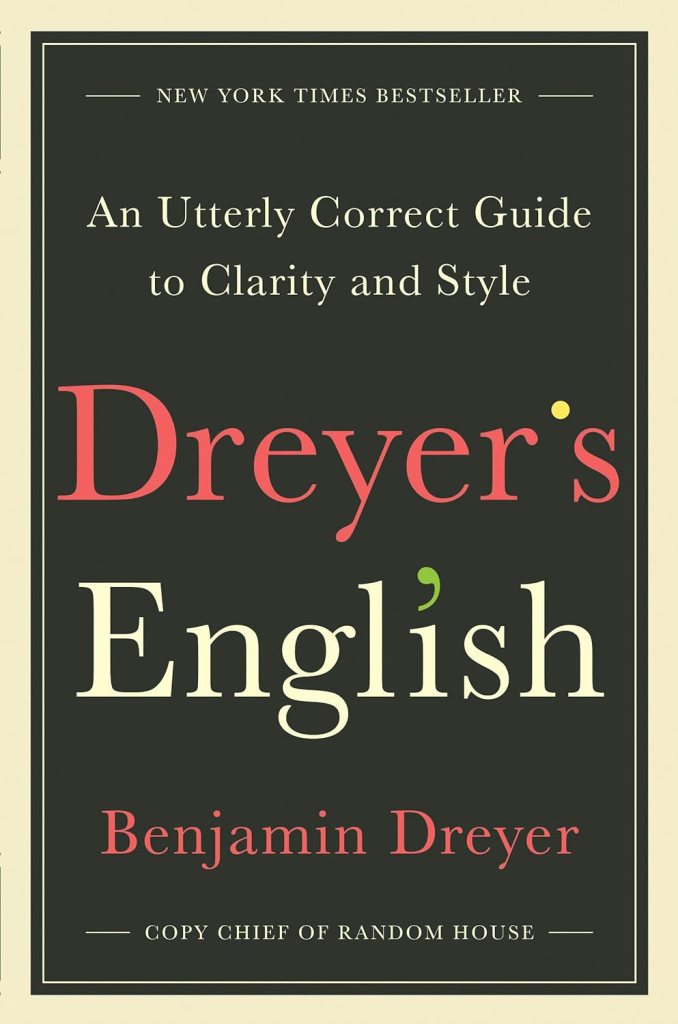
I asked her what she considered to be the bible for grammar and punctuation. Without missing a beat, she said Dreyer’s English by Benjamin Dreyer. That same night, I made the 20-minute walk to the local bookstore and emerged from its doors about $20 poorer and 320 pages richer.
I went into this book thinking that it was going to be dry, technical, and so boring.
Listen, the subject of grammar can only be so exciting. That being said, the book was actually super engaging and funny. You get lessons in the proper use of commas, semi-colons, commonly misspelled words, and so much more—each lesson laced with a fair bit of humor. (Some of that humor coming from the author making fun of Donald Trump’s tweets, haha.)
There are so many things I took from this book. For example:
The difference between “toward” and “towards.” As it turns out, both are correct—towards is just more commonly used in the UK.
I also learned about what Dreyer calls the “only comma.”
Example:
My cat, Meowly Cyrus, loves her cat food. (If the person only has one cat.)
My cat Meowly Cyrus loves her cat food. (If the person has more than one cat.)
I’m sure it sounds like I’m geeking out about this, and that is only because I am. Seriously, though, I learned so much from this book. It improved my writing immensely, and for that, I’m glad I invested the $20 and a few hours of my life reading this book. It was completely worth it.
Let me know of some different ways you’ve invested in your writing or another skill you’ve wanted to develop. Leave me comment below!

 ericeamador.com
Leave a comment